The UK roofing industry continues to grow as property maintenance, housing development, and climate-related damage drive demand for roofing services across the country. From major metropolitan areas like London and Manchester to rapidly expanding cities such as Leeds and Bristol, roofing contractors are seeing increased opportunities for both residential and commercial work.
This 2026 UK Roofing Demand Report analyses roofing demand across major cities, identifies emerging markets, and highlights the trends shaping the industry. Whether you are an established contractor or a growing roofing company looking to expand into new areas, understanding where demand is strongest can help you focus your marketing and lead generation efforts effectively.
Executive Summary
The UK roofing industry remains a stable and essential part of the construction sector. With millions of homes across the country requiring maintenance, repairs, and full roof replacements, the demand for professional roofing contractors continues to rise year on year.
Several key factors are driving roofing demand across the UK in 2026:
- An ageing housing stock — a large proportion of UK roofs are approaching or beyond their expected lifespan
- Increasing extreme weather events — storms, high winds, and heavy rainfall causing accelerated roof damage
- Rising home improvement spending — homeowners investing in upgrades and energy efficiency
- Continued urban housing development — new builds across multiple regions requiring roofing from the ground up
Key insight: Roofing contractors that invest in digital marketing and local search visibility are capturing a disproportionate share of the available leads. As homeowners increasingly search online rather than asking neighbours, digital presence has become the primary source of new enquiries for the top-performing roofing businesses.
Cities with the highest roofing demand include London, Manchester, Birmingham, Leeds, and Bristol. Regional markets including Sheffield, Glasgow, Liverpool, and Nottingham also offer strong, consistent opportunities.
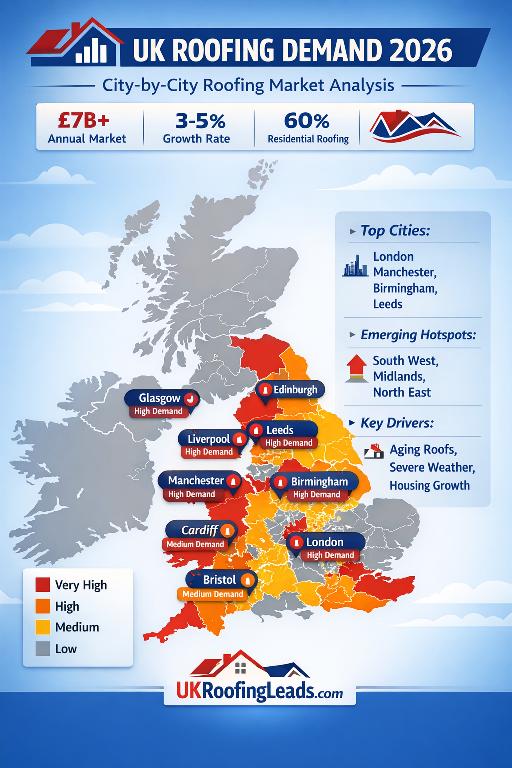
Overview of the UK Roofing Market
Roofing plays a crucial role in the maintenance and protection of residential, commercial, and industrial buildings. In the UK, the roofing sector is closely tied to the wider construction and property maintenance industries.
The market is supported by three primary segments:
- Residential roofing — the largest segment by volume, covering repairs, replacements, and maintenance on private dwellings
- Commercial roofing — flat roofs, industrial units, retail parks, and office buildings; higher average contract value
- Industrial roofing — warehouses, manufacturing facilities, and large-scale flat roofing systems
Residential projects make up the majority of roofing work in the UK, particularly in older cities where large housing estates were built between the 1930s and the 1970s. Many of these roofs are now reaching the age where replacement or major repairs are necessary, creating a long-term structural wave of demand that will continue throughout the decade.
Housing stock context: The UK has approximately 29 million homes. Of these, over 60% were built before 1980. With tile roofs lasting 50–70 years and felt flat roofs lasting just 20–30 years, a significant proportion of the housing stock requires attention within the next five to ten years.
Key Drivers of Roofing Demand in 2026
Understanding what drives roofing demand helps contractors anticipate where the most work opportunities will appear and how to position their services accordingly.
1. Ageing Housing Stock
One of the biggest and most consistent drivers of roofing demand is the age of UK housing. Typical roof lifespans vary significantly by material:
| Roof Type | Typical Lifespan | Most Common In |
|---|---|---|
| Natural slate | 75–100 years | Victorian, Edwardian properties |
| Concrete/clay tiles | 50–70 years | 1950s–1980s housing estates |
| Felt flat roof | 20–30 years | Extensions, garages, 1960s–1980s builds |
| EPDM flat roof | 40–50 years | Modern flat-roof extensions |
| GRP / fibreglass | 25–40 years | Contemporary residential extensions |
As roofs age, homeowners face issues including leaks, cracked tiles, damaged flashing, sagging, and structural deterioration — all of which create demand for roofing contractors whether the job is a repair or a full replacement.
2. Severe Weather Events
The UK frequently experiences severe weather conditions that can damage roofs. Storms, high winds, and heavy rainfall can loosen tiles, damage flashing, block guttering, and cause leaks. Climate trends suggest extreme weather events are becoming more frequent, which will likely continue to increase demand for emergency roof repairs and preventative maintenance.
Opportunity for contractors: Emergency roofing searches — "roof leaking urgently", "storm roof damage repair" — spike by 300–400% during and immediately after storm events. Contractors who have invested in Google Ads and strong Google Maps visibility capture this surge demand automatically. See our guide to emergency roof repair leads for more.
3. Home Renovation and Energy Upgrades
Homeowners across the UK continue to invest heavily in property improvements. Roof replacements, insulation upgrades, and loft conversions often require roofing work. The growing adoption of solar panels has created additional opportunities for roofing contractors who can install or modify roofing structures to accommodate solar systems — a trend expected to accelerate as energy costs remain elevated.
4. New Housing Development
The UK government has continued to push for increased housing construction to address the long-term housing shortage. Large developments are underway across multiple regions, particularly in Greater Manchester, the West Midlands, South West England, and Yorkshire — each representing significant roofing work opportunities for contractors with capacity and local visibility.
Top UK Cities With the Highest Roofing Demand
The following cities represent the strongest markets for roofing contractors in 2026, based on housing stock size, development activity, search demand data, and roofing service enquiry volumes.
London
Largest roofing market in the UK. Historic building stock, continuous property renovation, and high-value flat roofing projects. Strong demand for specialist slate and heritage restoration work alongside commercial flat roofing.
Highest VolumeManchester
Significant housing growth and urban regeneration have increased demand sharply. New apartment complexes alongside older terraced housing estates create a dual market for new-build and repair work.
Strong GrowthBirmingham
The UK's second-largest city with a vast residential housing stock and ongoing development projects. Urban regeneration and infrastructure investment have driven consistent roofing demand across residential neighbourhoods.
High DemandLeeds
One of the fastest-growing cities in northern England. New housing developments and commercial construction projects are creating consistent demand. Growing population and housing pressure suggest opportunities will continue to expand.
Fast GrowingBristol
Rapid population growth and increased housing development. A strong mix of historic housing requiring maintenance and new developments requiring installation creates consistent demand across multiple service types.
High Job ValuesLiverpool
Large housing estates and substantial property renovation projects create consistent roofing demand. Older Victorian and Edwardian stock in residential areas drives a high proportion of repair and replacement work.
Active MarketSheffield
A mix of older residential properties and growing suburban areas. Dense terraced housing stock across multiple districts creates reliable, recurring demand for repairs and maintenance alongside periodic replacements.
Dense HousingGlasgow
Scotland's largest city with a dense housing stock requiring ongoing roofing maintenance. Harsh Scottish weather conditions accelerate roof deterioration, generating above-average demand for both repairs and replacements.
Low CompetitionCity Roofing Demand Comparison
The table below provides a comparative view of roofing demand indicators across major UK cities, based on housing stock size, search volume data, and market activity.
| City | Housing Stock | Monthly Search Volume | Market Maturity | Key Opportunity |
|---|---|---|---|---|
| London | 3.5M+ homes | 22,000+ | High competition | Heritage & flat roofing |
| Manchester | 230,000+ homes | 4,400 | Growing | New build + repairs |
| Birmingham | 430,000+ homes | 3,600 | Active | Large replacement volume |
| Leeds | 330,000+ homes | 2,900 | Fast growth | New development + terraces |
| Bristol | 195,000+ homes | 2,400 | Growing | High-value jobs |
| Sheffield | 240,000+ homes | 2,100 | Stable | Recurring maintenance |
| Glasgow | 295,000+ homes | 2,800 | Low competition | Weather-driven demand |
| Edinburgh | 220,000+ homes | 1,900 | Premium market | High job values |
| Liverpool | 205,000+ homes | 1,800 | Active | Victorian stock repairs |
| Nottingham | 135,000+ homes | 1,200 | Emerging | Midlands expansion |
Regional Roofing Demand Breakdown
Beyond individual cities, roofing demand follows broader regional patterns that are useful for contractors considering geographic expansion.
South East England
The South East remains one of the strongest roofing markets due to high housing density, older stock, and ongoing property development. Cities such as London, Brighton, Reading, and Southampton generate consistent demand. Property values in the region also mean homeowners are generally more willing to invest in quality roofing work — pushing average job values higher than in other regions.
Midlands
The Midlands region, including Birmingham, Leicester, and Nottingham, has seen increasing development activity driven by the HS2 rail project and associated regeneration. Urban renewal projects and suburban housing expansion continue to create roofing opportunities across both residential and commercial sectors.
Northern England
Northern cities — Manchester, Leeds, Liverpool, Sheffield — have benefited from significant infrastructure investment and property redevelopment over the past decade. These cities offer strong growth potential, particularly for contractors who can combine new-build roofing with maintenance and repair work on the region's large older housing stock.
Scotland
Scotland's major cities, particularly Glasgow and Edinburgh, maintain consistent demand for roofing repairs and replacements. Harsh weather conditions — including frequent storms, heavy rainfall, and freeze-thaw cycles — accelerate roof deterioration and generate above-average demand for both emergency repairs and preventative maintenance.
Wales
Cardiff and Swansea have experienced steady housing growth, driving roofing demand across residential areas. Welsh government housing development programmes have also contributed to new-build roofing opportunities, particularly in and around Cardiff.
Roofing Demand by Service Type
Roofing contractors typically offer a variety of services, each with different demand levels, job values, and seasonality. Understanding the breakdown helps contractors focus marketing spend on the highest-volume and highest-value segments.
Roof repairs represent the largest share of market volume because many homeowners prefer fixing issues over replacing entire roofs — and because repairs are triggered by events (storms, leaks) that force an immediate decision, generating high-intent searches. Despite being the smallest segment by volume, emergency repairs often have the highest conversion rates of any lead type because the homeowner has an urgent, non-deferrable need.
Commercial roofing note: Although commercial roofing represents only 10% of market volume, individual contracts are significantly larger — often worth £10,000–£100,000+ compared to £1,500–£8,000 for typical residential jobs. Contractors who can access commercial roofing leads can achieve substantially higher revenue from fewer jobs.
Seasonal Roofing Demand Patterns
Roofing demand varies significantly throughout the year. Understanding seasonal patterns allows contractors to plan their marketing spend and capacity accordingly.
Marketing strategy tip: Run Google Ads year-round but increase budgets in autumn and after storm events. Emergency repair keywords spike immediately after adverse weather — contractors with active campaigns capture this demand automatically. Those without paid search are invisible during their highest-converting moments of the year.
Roofing Lead Generation Trends in 2026
Roofing contractors traditionally relied on directories, word of mouth, and referrals for new business. That model is changing significantly, and the contractors adapting to digital lead generation are pulling ahead of those who haven't.
The Shift From Directories to Google
While platforms like Checkatrade and Rated People still generate enquiries, there is a clear shift in how homeowners find roofing contractors. In 2026, the majority of roofing searches begin on Google, with the Map Pack (top three local business listings) capturing over 80% of clicks. Homeowners increasingly call directly from the Google Maps listing — bypassing comparison platforms entirely.
✅ Google-Based Lead Generation
- Calls come directly to you — fully exclusive
- Homeowner already decided they need a roofer
- No platform subscription required
- Rankings and reviews compound over time
- You own the asset — it doesn't disappear if you stop paying
❌ Checkatrade / Lead Marketplaces
- Same lead sold to 3–6 contractors simultaneously
- Price competition on every job
- Subscription costs £800–£2,400/year before any leads
- Stop paying, leads stop immediately
- You build their asset, not yours
Exclusive lead generation services are becoming more popular precisely because they give contractors the economics of Google (one homeowner, one contractor) without requiring the roofer to manage the marketing themselves. For a detailed breakdown of every channel, see our roofing marketing guide for UK contractors.
Local SEO and the Map Pack
For UK roofing contractors, ranking in the Google Map Pack (the top three results shown on local searches) is the single highest-ROI marketing activity available. A contractor appearing in positions 1–3 for "roofer near me" in their city will typically receive 8–25 exclusive inbound calls per month at zero cost per lead. Our local SEO service is specifically built to achieve and hold that position.
Google Ads for Emergency Demand
While SEO builds long-term organic visibility, Google Ads provides immediate access to emergency and high-intent searches. A well-managed Google Ads campaign for a UK roofing contractor typically delivers leads at £25–£65 per enquiry — significantly cheaper than Checkatrade on a cost-per-job basis, with far higher exclusivity. See how our Google Ads service for roofers works.
Case Study: Digital Lead Generation in Manchester
A roofing contractor in Manchester implemented a targeted digital lead generation strategy focused on local search visibility — combining Google Business Profile optimisation, local SEO, and Google Ads across their service area.
The strategy centred on ranking in the top three Google Maps results for "roofer Manchester" and related emergency repair searches. By the third month, the contractor had moved from position 8 to position 2 in the Map Pack, generating a consistent flow of direct inbound calls without any ongoing lead marketplace subscriptions.
The key difference: Every one of the 47 enquiries came directly to the contractor's phone. None were shared with competing roofers. The homeowner had searched, found the business, and called — the highest-converting type of lead available in the roofing industry.
Future Roofing Industry Trends
Several trends are expected to shape the UK roofing industry over the next five to ten years. Contractors who anticipate these shifts can position their services ahead of changing demand.
Solar Roof Installations
Solar panel installations continue to increase across the UK, driven by elevated energy costs and government incentives. Roofers who offer solar-ready roofing installations or who partner with solar installation companies may gain a significant competitive advantage. Many homeowners are now planning roof replacements and solar installations simultaneously — creating higher-value combined contracts.
Eco-Friendly and Sustainable Roofing Materials
Environmentally sustainable roofing materials are becoming more popular among homeowners and developers. Green roofs, recycled slate, and energy-efficient insulated roofing systems are expected to grow in demand as planning regulations and homeowner preferences shift toward sustainability. Contractors who can offer and install these materials will access a premium market segment.
Smart Roofing Technology
Advances in roofing technology are introducing smart monitoring systems that detect leaks and structural issues before they become visible. As these systems become more affordable, they may create new maintenance and installation opportunities for roofing contractors — particularly in the commercial and high-value residential segments.
Digital Lead Generation Becoming the Norm
The shift from directory-based lead sourcing to owned digital channels (Google Maps, SEO, paid search) is expected to accelerate throughout 2026 and beyond. Roofing companies that establish strong Google presence now will compound that advantage over time — while those still reliant on Checkatrade will face increasing competition and margin pressure as the platform raises subscription fees.
Conclusion
The UK roofing industry remains a strong and stable market with consistent demand for skilled contractors. Ageing housing stock, unpredictable weather conditions, and continued housing development ensure that roofing services will remain essential for years to come.
Cities such as London, Manchester, Birmingham, Leeds, and Bristol currently offer the strongest roofing demand, but many regional markets — Sheffield, Glasgow, Liverpool, Nottingham — also provide excellent opportunities for contractors with strong local visibility.
The contractors winning the most business in 2026 are those who have invested in Google-based lead generation — owned channels that compound over time, generate exclusive enquiries, and don't disappear when a subscription lapses. The market opportunity is significant. The question is whether your business will be visible when a homeowner searches for a roofer in your area.